ಋಗ್ವೇದ
Rigveda
A collection of Vedic hymns and invocations. Its verses praise deities such as Agni, Indra, Varuna and others, and include celebrated hymns such as the Purusha Sukta and Nasadiya Sukta.
The word “Veda” is associated with knowledge, and Vedic learning is understood as a lifelong pursuit rather than simply the completion of a textbook.
ಋಗ್ವೇದ
A collection of Vedic hymns and invocations. Its verses praise deities such as Agni, Indra, Varuna and others, and include celebrated hymns such as the Purusha Sukta and Nasadiya Sukta.
ಯಜುರ್ವೇದ
The Veda closely associated with ritual action. It contains mantras and formulas used in the performance of Vedic rites. Krishna Yajurveda includes the Taittiriya tradition, which is the principal focus of Shree Gautama Veda Patashala.
ಸಾಮವೇದ
The Veda especially associated with chant and melody. Its verses are arranged for singing in particular musical patterns and preserve a distinctive oral tradition.
ಅಥರ್ವವೇದ
A collection that includes prayers and hymns relating to well-being, protection, peace, household life and other aspects of human experience.
Four Vedas, four fruits on every branch, and six Vedāṅgas that hold it all together.
Every Veda bears the Saṃhitā, Brāhmaṇa, Āraṇyaka and Upaniṣad. The six Vedāṅgas are the roots that keep each Veda pronounced, understood and applied.
A shakha is a particular branch or recension of a Veda, preserved by a lineage of teachers. Each shakha maintains its own form of recitation and associated textual traditions. Shree Gautama Veda Patashala focuses on the Krishna Yajurveda, Taittiriya Shakha, and its teaching should be understood within that specific lineage.
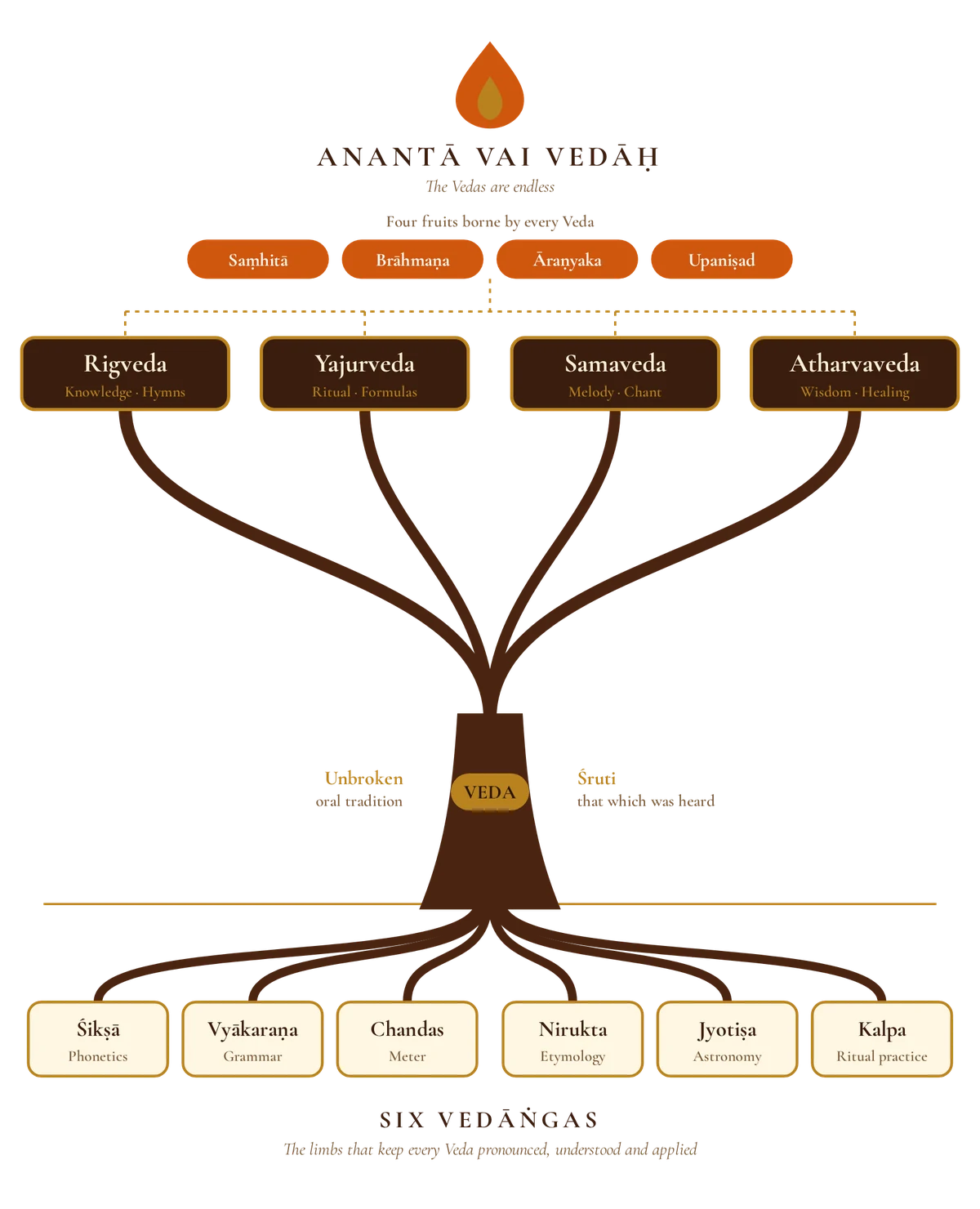
The Vedangas are six supporting disciplines traditionally studied to help preserve, pronounce, understand and apply Vedic knowledge.
ಶಿಕ್ಷಾ
Phonetics and correct pronunciation, including sounds, accent and duration.
ವ್ಯಾಕರಣ
Grammar and the structure of words and sentences.
ಛಂದಸ್
Metre and the rhythmic structure of Vedic verses.
ನಿರುಕ್ತ
Explanation of words, including their origins and meanings.
ಜ್ಯೋತಿಷ
Astronomy and calendrical knowledge used in determining appropriate times for traditional observances.
ಕಲ್ಪ
Rules and procedures relating to Vedic rituals and traditional practices.
In Vedic learning, sound is not incidental to the lesson. The student listens closely to the Acharya, repeats each passage and receives correction until pronunciation and recitation become steady. Traditional patterns such as Saṃhitā, Pada, Krama, Jata and Ghana, where included in a student's course, help reinforce the accurate preservation of the text.
For Shree Gautama Veda Patashala, preserving the Vedas also means sustaining the discipline, ethical outlook and cultural memory connected with their study. Careful learning, respect for life, self-restraint, responsibility and service remain values that students can carry into their families and communities.
Shree Gautama Veda Patashala welcomes those who wish to learn more about Vedic oral learning and the Krishna Yajurveda Taittiriya tradition.